
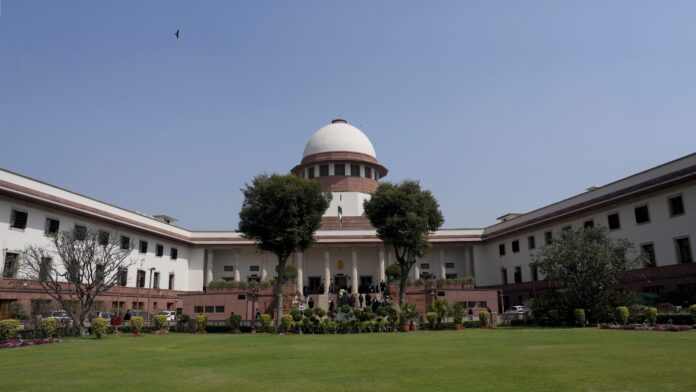
The Supreme Court of India has raised significant concerns regarding a troubling trend where judges issue numerous orders just before their retirement. Chief Justice of India Justice Surya Kant made this observation during a recent hearing, comparing the practice to a batter ‘hitting sixes in the final overs’ of a cricket match.
This commentary arose during the examination of a petition from a Principal District and Sessions Judge in Madhya Pradesh, who contested his suspension just 10 days prior to his scheduled retirement.
“It is an unfortunate trend. There is a growing tendency of judges passing so many orders just before retirement,” stated CJI Surya Kant. The court’s Bench included Justices Joymalya Bagchi and Vipul M. Pancholi, all echoing similar sentiments regarding the implications of this trend.
The affected judicial officer was initially set to retire on November 30, but has faced suspension effective from November 19, following a decision by the Full Court of the Madhya Pradesh High Court. His suspension allegedly stemmed from at least two judicial orders passed in proximity to his impending retirement.
Senior advocate Vipin Sanghi, representing the petitioner, argued vigorously that his client held an unblemished service record, consistently receiving high ratings in his Annual Confidential Reports (ACRs). He posed a critical question, asking: “How can an officer be suspended for judicial orders that are appealable and can be rectified by higher courts?”
In a noteworthy turn, the Supreme Court appeared to concur with Sanghi’s argument, stating that disciplinary actions are not typically warranted for judicial errors. However, CJI Surya Kant raised a caveat, asking, “But what if the orders are palpably dishonest?” This highlights the nuanced distinction the court sought to draw between genuine judicial errors and blatant misconduct.
Further complicating the situation, on November 20, the Supreme Court directed the Madhya Pradesh Government to raise the retirement age of judicial officers from 60 to 61 years. This directive means that the petitioner is now slated to retire on November 30, 2026. The Chief Justice pointed out that the judicial officer was unaware of this change when he made his earlier orders.
During the proceedings, the court also inquired why the officer did not approach the High Court to contest his suspension directly. Sanghi clarified that due to the Full Court’s decision, the petitioner felt justified in approaching the Supreme Court. Nevertheless, the Bench noted that Full Court decisions can be contested and potentially overturned in judicial proceedings.
The court also criticized the officer’s tactic of utilizing the Right to Information (RTI) Act to gather information about his suspension, stating, “It is not expected of a senior judicial officer to resort to the RTI route. He could have submitted a representation.”
Ultimately, the Supreme Court chose not to entertain the petition at this time but granted the judicial officer the liberty to submit a representation to the Madhya Pradesh High Court requesting a recall of the suspension order. The Bench directed the High Court to consider this representation and make a determination within a deadline of four weeks.

